On north eastern Spain is the maritime province of GERONA which borders France and
is the easternmost province on the Iberian Peninsula bounded by the Pyrenees to the
north along the frontier with France until they reach the Costa Brava. It has a variety
of climates and landscapes with forests, meadows, fields and reservoirs. For those
looking for winter sports, there are ski resorts at La Molina, Nuria, Masella and
Vallter Tean 2000 all equipped with ski-lifts.
Various monuments and archaeology features may be found in Ripoll, Besalú, Pals,
Ullastret, Ampurias, Rosas, Figueras and many more. From Barcelona, Gerona is 100
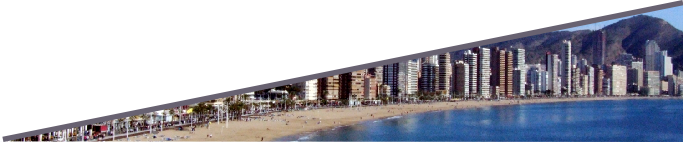
km and from the French border 60 km. The coastline, known as the Costa Brava is an
interesting area for the tourist since they can visit popular tourist centres such
as Lloret de Mar, Playa de Aro, Blanes, Palamós, Palafrugell, etc. as well as typical
towns like Cadaqués, Puerto de la Selva, Llansä and many more, with quiet protected
beaches with clean sand and pine trees that grow right down to the waters edge
The first inhabitants in the region were Iberians; Gerona is the ancient Gerunda,
a city of the Ausetani. Later, the Romans built a citadel there, which was given
the name Gerunda. The Visigoths ruled in Girona until it was conquered by the Moors.
Finally, Charlemagne reconquered it in 785 and made it one of the fourteen original
countships of Catalonia.Thus it was wrested temporarily from the Moors, who were
driven out finally in 1015. Guifré I incorporated Girona to the countship of Barcelona
in 878. Alfonso I of Aragón declared Girona to be a city in the 11th century. The
ancient countship later became a duchy (1351) when king Pere III d' Aragó gave the
title of Duke to his first-born son, Joan. In 1414, King Ferran I in turn gave the
title of Prince of Girona to his first-born son, Alfons. The title is currently carried
by Prince Felipe, Prince of Asturias, the first Borbón to do so.
The 12th century saw a flourishing of the Jewish community of Girona, with one of
the most important Kabbalistic schools in Europe. The Rabbi of Girona, Moshe ben
Nahman Gerondi was appointed Great Rabbi of Catalonia. The history of the Jewish
community of Girona ended in 1492, when the Catholic Kings expelled all the Jews
from Spain. Today, the Jewish ghetto or Call is one of the best preserved in Europe
and is a major tourist attraction. On the north side of the old city is the Montjuïc
(or hill of the Jews in medieval Catalan), where an important religious cemetery
was located. Girona has undergone twenty-five sieges and been captured seven times.
It was besieged by the French royal armies under Marshal Hocquisicourt in 1653, under
Marshal Bellefonds in 1684, and twice in 1694 under de Noailles. In May, 1809, it
was besieged by 35,000 French Napoleonic troops under Vergier, Augereau and St. Cyr,
and held out obstinately under the leadership of Alvarez until disease and famine
compelled it to capitulate. Finally, the French conquered the city in 1809, after
7 months of siege. The defensive city walls were demolished at the end of the 19th
century to allow for the expansion of the city.
In recent years, the remaining parts of the eastern city walls were reconstructed
and now the Passeig de la Muralla forms a touristic walking route around the old
city.