Santiago de Compostela, a UNESCO "World Heritage City", is one of the most historically
and culturally significant cities in Europe. For over a millennium, pilgrims have
followed the Camino de Santiago to this city of medieval origins in northwestern
Spain, where, according to legend, the body of Saint James was miraculously discovered
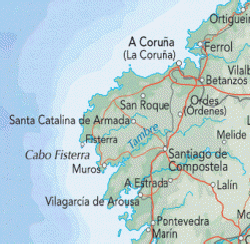
during the ninth century. Located in the autonomous community of Galicia in northwestern
Spain, Santiago offers a fairly cool, moist climate with beautiful green countryside.
The Atlantic coast is nearby, with a spectacular landscape of dramatic cliffs, rocky
inlets, and sandy beaches.
Santiago is a dynamic, cosmopolitan city with a fascinating mixture of new and old.
While it continues to be a popular site for European tourists and spiritual pilgrims
alike, it is also a major college town. Santiago, in addition, functions as the political
and cultural capital of Galicia and thus offers broad range of activities, concerts,
sporting events, museums and theatres. The great majority of Santiago's population
is composed of students, and, as such, it is a city that constantly caters to their
needs and interests.
Santiago is one of the most famous places of pilgrimage worldwide, so of course many
of its traditional festivities are of religious character.
Semana Santa, Easter week, is celebrated as in most major Spanish towns with impressive
processions.
In May takes place the interesting Feria del Ganado, which lasts for 10 days. Apart
from performances by folklorist groups it is also a culinary festival, and you have
a great opportunity to try all the specialties of the regional kitchen.
If you are in Santiago at the end of July, don't miss the Festival of the Apostle.
On July, 24th the "Fuego del Apostol" a great fire-works display takes place in front
of the Obradoiro-door of the cathedral. The next day, during mass, a huge incense
font that is fixed to the ceiling of the cathedral with a rope is swung through all
the nave. In August and September an important Festival of Classical Music takes
place with numerous concerts
The name Santiago goes back to the Apostle James (Saint James = Santiago) who went
to this most north-western part of Spain, called by the Romans "Finis Terrae", "end
of the world", to preach and convert people to Christianity.
After returning to Palestine in 44 AD., he was taken prisoner by Herod Agrippa and
tortured to death. The king decreed that it was forbidden to bury him, but in the
night Jacob's disciples stole the body and brought him, in a sarcophagus of marble,
on board of a small boat. The current of the sea drove the boat to the Spanish coast,
into the port of the Roman province's capital, Iria Flavia. Here the Apostle was
buried at a secret place in a wood.
Centuries later, in 813, the hermit Pelayo heard music in that wood and saw a brightly
shining star. This place was called, in Latin, "Campus Stellae", field of the star,
the name that was later turned into Compostela.
Bishop Teodomiro, who received notice of that event, instigated an investigation,
and so the tomb of the Apostle was discovered. King Alphonse II declared Saint James
the patron of his empire and had a chapel built at that place. It is reported that
from then on Saint James did several miracles, it was even said that he fought side
by side with King Ramiro I in the decisive battle against the Moors.
More and more pilgrims followed the way of Santiago, "Camino de Santiago", and the
original chapel soon became the cathedral of the new settlement, Santiago de Compostela.
In 12th and 13th century the town had its greatest importance, and Pope Alexander
III declared it a Holy Town, like Rome and Jerusalem. Pope Calixto II declared that
the pilgrims who went to Santiago in a Holy Year should be free of all their sins.
El Año Santo (Holy Year) is celebrated each time when the Apostle's day (July, 24)
is a Sunday.