The municipality of La Coruña lies in the extreme north west of Spain and forms part
of the autonomous region of Galicia. It is an Atlantic city with a moderate climate.
Given the relative shortage of land and the need for expansion, the land is more
profitable as a base for building. Farming activities are therefore more centred
in the surrounding areas. Even so, as a coastal city, fishing is a very significant
industry in La Coruña (due more to the indirect work posts it creates than the direct
ones). All this means that the main sector in the city is services - it is the economic
and cultural centre of the area and plays the role of a regional metropolis not only
in the province but in all Galicia.
There have been various changes in the city's structure over the last few decades
- it now shares some administrative functions and is less of a military centre. Companies
have grown, especially in certain sub-sectors such as finance, communication, layout
and sales, manufacturing, technical services and the port itself (it is the largest
in Europe in terms of fresh fish unloaded), with the increase in other port activities
like crude oil and solid bulk, making up 75% of Galician port traffic.
La Coruña reached its height as a port and a textile centre in the late Middle Ages.
The Armada sailed from its harbour in 1588. The city was sacked by Sir Francis Drake
in 1598. In the Peninsular War it was the scene of the battle (1809) in which Sir
John Moore was killed. The city was a focus of anti monarchist sentiment during the
19th century
The city has been re-launched over the past few years with better access, an improved
cultural, sporting, leisure and scientific infrastructure, a better framework, the
recovery of the shoreline and the strengthening of the tourist sector. All this has
reaffirmed the city's existing character as a centre for administration, sales, port
activities, culture and tourism.
The Tower of Hercules
The only Roman lighthouse in the world that is still working. It dates from the 2nd
century AD, and in spite of various structural renovations it still maintains its
original form. The top is 112 metres above sea level, providing spectacular views.
It is the most international of the city's symbols.
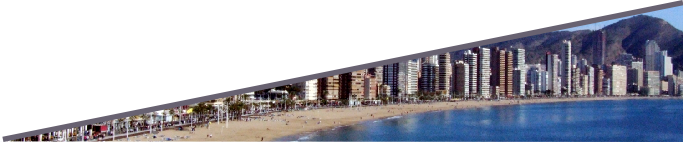
La Coruña is surrounded by the sea, which means that people can enjoy over 2 kilometres
of marvelous beach in the very heart of the city.
Apart from the Orzán Bay beaches, the city coastline is dotted with smaller beaches
and coves for all tastes and with all the services. Water and beach quality is evident
from the blue flags flying in the wind.
Among the cultural centres in the city, special mention should be made of the Congress
Hall, home to the Symphonic Orchestra of Galicia and thus recently re-christened
the Opera House the Rosalía de Castro Theatre and the Coliseum, a very flexible building
which can even be used as a bull ring.