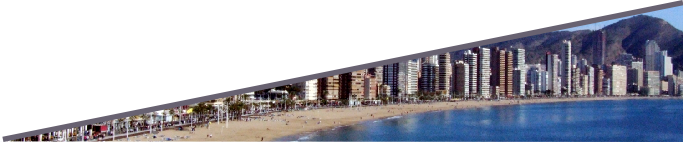
Santander, the capital of Spain's Cantabria region, is blessed with a physical beauty
few towns can match. Set on a tranquil bay, its landmass undulates into lush green
stretches for parks, golf courses and long romantic walks, and sandy coves for beaches.
Obviously, the Spaniards know their country well-in the summer months, many rush
north for relief from the hard-bitten sun of the south to Cantabria's cool air and
broad spaces.
The town retained its turn-of-the-century charm when the Spanish nobility discovered
it and made it one of their preferred getaways. Unfortunately, Santander is missing
a very old portion of town--the kind Americans love to visit. Due to a fire in 1941,
the town lost much of its city centre, and with it an ancient heritage. Still, it
is a very attractive city for leisure visitors and a great base from which to visit
Picos de Europa National Park, which soars at more than 7,500 feet at its rugged
peak.
The bay is undoubtedly one of the city's most recognizable icons. Its calm water
changes colour depending on the wind, creating a kind of magical element. A walk
along the bay takes visitors to the Barrio Pesquero, a fisherman's area lined with
gritty taverns and earthy restaurants. Further along is a street called the Paseo
de Pereda, locale of Pereda Gardens, known as the "lungs of the city." Although the
buildings along the coast vary, there is a strange architectural unity-they all feature
balconies made of wood and glass. Along the bay front is the International Festival
Hall of Santander, a modern, box-like building that has the capacity to drop a wall
and open itself to the bay for performances held under the stars.
The Reina Victoria, Santander's main avenue, is among the most beautiful maritime
avenues in Spain. Reina Victoria takes visitors to the Magdalena Peninsula, home
to the English-style Magdalena Royal Palace. It was the summer residence of King
Alfonso XIII and is now a fabulous venue for university and summer courses.
Beyond the peninsula, visitors head toward elegant El Sardinero, an area featuring
magnificent beaches, the Gran Casino and the Piquio Gardens, which offers panoramic
views across the bay. Perhaps the best way for visitors to get an orientation of
the city is to board one of the bay's sightseeing motorboats and take a trip to the
lighthouse of Cabo Mayor, located on high, steep cliffs.
Santander is also a great base from which to see some of the country's most talked-about
sites. For instance, Bilbao, in the Basque region is a two-hour drive, and is also
easily reachable by train or bus. Visitors can take a full-day trip to the Guggenheim
Museum in Bilbao and sample the region's version of tapas, called pintxos. In addition,
one of the highest mountains in Europe, the Picos de Europa, is about a three-hour
drive from Santander, and along the way there are numerous villages to visit, breathtaking
gorges to see and tiny inns at which to dine. Not far from Santander is the town
of Santillana del Mar, a romantic medieval town known as one of the best preserved
in Europe. Closer still is a marvellous zoo called Cabarceno, which is set in the
former iron mines that had been operated by the Romans for thousands of years.